
Mastering PTE Pronunciation: Unlock the Secret of Consonant Clusters
In the PTE Speaking test, pronunciation is one of the three main categories that impact your score. Today, let’s explore a powerful strategy to maximize your pronunciation score: mastering consonant clusters.
What Are Consonant Clusters?
In English, letters are categorized into vowels and consonants.
- Vowels are sounds you can pronounce independently (a, e, i, o, u).
- Consonants need a vowel to form a sound. For example:
- K + a = ka
- K + i = ki
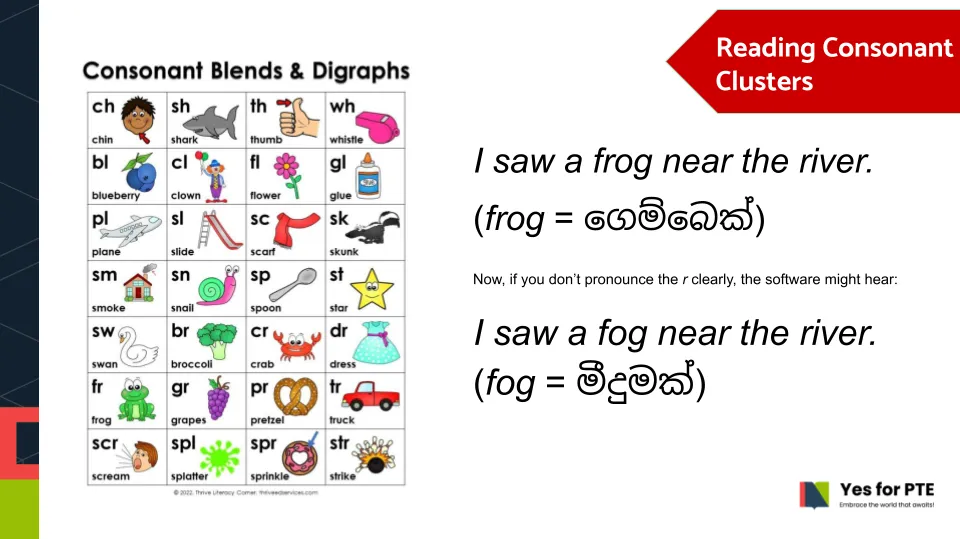
Now, here’s where it gets interesting. Many English words have groups of consonants placed together without vowels between them, called consonant clusters. For example, in the word frog, both f and r are consonants.
When reading such words, there’s a high chance of missing a sound, which can reduce your pronunciation score. Worse, it could alter the meaning of the word entirely, affecting the sentence’s overall sense.
Why Do Consonant Clusters Matter?
Let’s look at an example:
Correct sentence:
I saw a frog near the river.
(frog = ගෙම්බෙක්)
Now, if you don’t pronounce the r clearly, the software might hear:
I saw a fog near the river.
(fog = මීදුමක්)
See the difference? A small pronunciation mistake can change the meaning of your sentence completely.
This is a common issue in PTE Speaking, especially in tasks like Read Aloud. The good news? It’s easy to fix with some focused practice!
How to Master Consonant Clusters
Here’s a quick action plan to get you started:
- Focus on Clear Articulation
Break down the word and emphasize each consonant in the cluster. For example:- f-r-o-g
- Practice saying f and r clearly before joining them.
- Record Yourself
Use your phone to record yourself reading sentences with clusters. Play it back to check if all sounds are clear. - Practice Common Clusters
Start with simple words and gradually move to complex ones:- frog, blend, twist, crafts, glimpses.
- Use PTE Practice Materials
Read Aloud tasks in PTE practice apps often include words with clusters. Make them part of your daily preparation. - Slow Down
Rushing can cause you to skip sounds. Speak clearly and at a steady pace to avoid missing consonants.
Why Join Our PTE Rapid Boost Course?
At Yes for PTE, we specialize in helping students overcome challenges like consonant clusters and improve their pronunciation. Our PTE Rapid Boost Course is designed to give you practical strategies and tips to nail the Speaking section in record time.
Want to fast-track your PTE preparation?
👉 Inquire now via WhatsApp at 0713038448 to learn more.
Let’s make your PTE journey a success!
Want to Know More? If you’re curious about more PTE strategies and recent updates, join our FREE info session. We’ll guide you through 15 key insights that can help you ace the test, whether you’re studying independently or considering a class.
Ready to dive in? Click the link below to reserve your spot in our next session!